


By: LESLIE MANNING & NICOLAS FIERRO
Salina Post
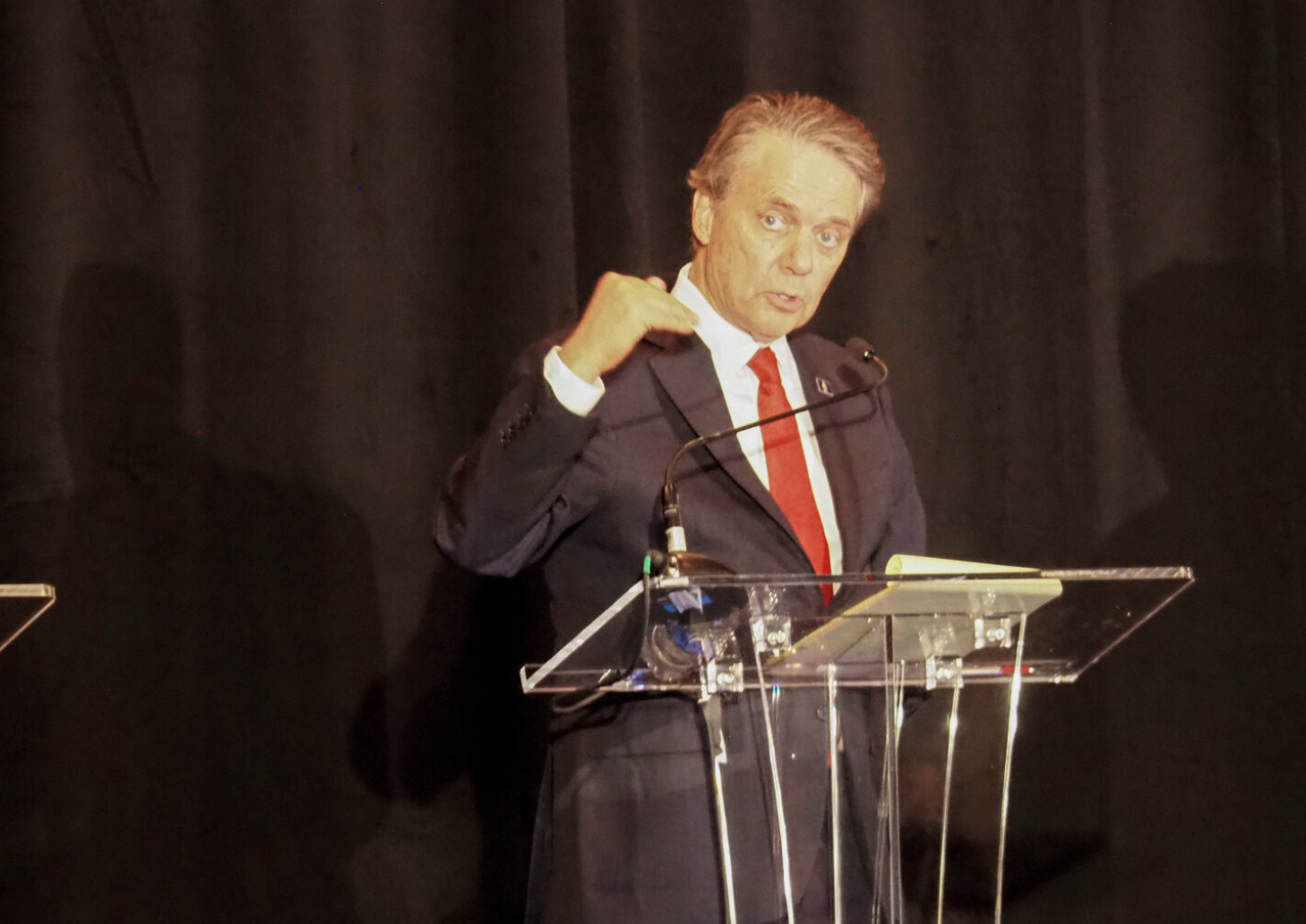
The Kansas Republican Party hosted the first gubernatorial debate for Republican candidates on the primary ballot for Tuesday, August 4. The debate was held during the Kansas Republican Party Winter Convention on Friday, January 30 at the Wichita Marriott.
Six of nine Republican candidates running for the Governor seat were included in the debate, who met the Kansas Republican Party’s debate participation requirements.
“A committee from across the state decided on a debate agreement unanimously,” Rob Fillion, Kansas Republican Party executive director, said. “It included a finance and unity agreement for the candidates. Six of our candidates chose to sign the agreement.”
The six candidates featured in the debate, drawing numbers to determine their order on stage, were Charlotte O’Hara, Jeff Colyer, Scott Schwab, Ty Masterson, Joy Eakins and Philip Sarnecki. Kansas Insurance Commissioner Vicki Schmidt, Doug Billings, and Stacy Rogers were not included.
Moderator Andy Hooser opened the debate with two minute statements from each candidate.
Opening statements
Charlotte O’Hara, a former Johnson County commissioner and former state representative for District 27, opened the debate with a memory from being raised on a farm in Bourbon County.
“I learned equal opportunity leaning into the flank of an old Holstein cow,” O’Hara said.
O'Hara highlighted having a background in agriculture as she proceeded to jab several candidates, resulting in Schwab and Masterson receiving an extra 45 seconds to refute her accusations.
Schwab voiced the election ballots in Johnson County were destroyed after the 2020 elections, because after waiting for a warrant that never showed, the county voted to destroy the ballots as the law says.
Masterson skirted around the accusations from O’Hara of chumming with Governor Laura Kelly on economic development projects.
“That type of thing is why we lose in the general election - we spend time cutting each other off at the legs,” Masterson said. “This is not the enemy. The Democrats are the enemy.”
Jeff Colyer, who served as the lieutenant governor during the Brownback Administration, and then gained the position of Kansas Governor in 2018 for one year when Governor Sam Brownback was nominated as the new U.S. Ambassador-at-Large for International Religious, spoke second.
“I’m running for governor to make this the best place to raise a family and have a small business,” Colyer said. “We will be the beating heart of American again.”
Colyer laid out a plan of developing higher paying jobs, lowering taxes and initiating a property tax lid; promoting education to world class; eliminating fraud; deporting illegal immigrants and restoring Kansas common sense.
Third at the microphone was Schwab, explained his campaign message - "Modernize, Revitalize and Fix" - with experience from his seven years as the current Kansas Secretary of State.
“When I became the Secretary of State, I came into a computer system purchased in the 1980s,” Schwab said. “We migrated off it, and went from annual filings to bi-annual filings. It cut our work load in half, so we were able to cut fees. Day one, I would tell every agency you need to modernize, reduce or both.”
Schwab also spoke on leveraging Kansas as the agricultural epicenter of the North American continent to bring manufacturing back to rural communities, while aiming to afford tax cuts.
Masterson, emphasized of being a "battle-tested, proven leader" and talked about various highlights he has accomplished as Senate President.
“I’m running because I’m a battle-tested, proven leader and I have the record and relationships to continue to deliver,” he said. “Ultimately, what I learned in my spot, in the legislature the sword I wield is just not powerful enough to slay the dragon of government overreach when you have a Democrat machine in the office.”
Masterson ended his opening statement for governor by advocating for improving property tax and education.
Joy Eakins, former Wichita school board member, former chair of the Wichita Chamber of Commerce and business owner, described how her experiences have primed her to lead a "Kansas Comeback," which would include school choice, tax and spending reforms and a resistance to government incentives for businesses and entrepreneurs.
“I’ve had a front row seat of what happens in Topeka for over a decade,” Eakins said. “What I’ve seen is too often, career politicians are protecting their own power instead of serving people.
The last to speak, Phil Sarnecki, a businessman and financial services executive, also differentiated himself from career politicians, touting his three decades of building businesses and creating jobs across the state as the skills he would bring to the governor’s office.
“Career politicians are failing us,” Sarnecki said. “I am tired of watching Republicans lose.”
Sarnecki also shared the importance of advocating for better income tax and property taxes.
The mention of career politicians allowed Schwab, Colyer and Masterson 45 seconds to each defend their careers in public service.
“It’s a career, and I’m proud of it,” Schwab said. “I’ve overseen two presidential elections, and 105 county election clerks. Having experience to understand the terrain has always been a plus in America.”
Masterson responded similarly, in his warrior style.
“That is the battle test, in understanding how the machine works, how the process works, where the bodies are buried and who to work with,” Masterson said. “I’m a career fighter.”
Colyer, though seven years away from Topeka, defended his time in office.
“All throughout my career, I have always worked taking care of Kansans on their worst days,” he said.
Different views on certain topics
Tax relief, STAR Bonds used for economic growth and education had different views from each of the candidates in attendance.
Tax relief
Colyer put his sights on controlling mill levy, the appraisal costs process and spending.
“The math is this - the appraisals and what they cost, and it is also what is the mill levy,” Colyer said. “You multiple those to get the total amount. You have to control both of those. That is what we need as a constitutional amendment that puts a cap on all of that. We need to control all of this, but in order to get there, you need to control the spending.”
Schwab pushed for a free market in property tax lids, placing property tax in school boards and a budgetary restraint on local units of government.
“Whatever we put in our constitution, as it relates to property taxes, it has to be free market," said Schwab.
Masterson emphasized putting more money in people's pockets through income and property tax reforms, while implementing aspects of the Working Family Tax Cut Act.
“Until we get a governor that will sign these things, and we don’t need overrides, we can’t get there,” Masterson said.
Eakins brought up her property tax reform plan that would one, make appraisals fair and predictable, two have homeowners in charge and place the burden of proof on government and three, create property tax relief funds.
“The government shouldn’t automatically grow it’s funds just because they are growing,” Eakins said. “They should put aside some of that money to buy down the taxes for people like seniors, veterans and working families.”
Sarnecki voiced on growing the economy with tax relief and releasing property tax credits. He also stated a three percent cap in the legislature on the assessment limit is "not enough" tax relief for Kansans.
"If you do that, you are going to leave the door wide open on the levy side of things for local taxing bodies to come in and just raise the mill rate," Sarnecki said. "What you can do with tax relief when you grow an economy, that’s what I’ve been doing for 30 years growing businesses."
O'Hara also versed in business ownership as family members own a general contracting firm, small manufacturing operation and rent industrial buildings, attacked tax incentives.
"We are giving tax incentives away like candy,” O’Hara said. “There are 101 tax incentive programs on the commerce department’s website. We are giving the wealthiest of the wealthy all these tax breaks, and you get to pay the bill.”
STAR Bonds used for economic growth
Though the topic surrounded of on if STAR Bonds could be used as a tool for economic growth, the candidates took different routes on how to address it.
Schwab discussed on seeking new tools for economic growth, other than STAR Bonds. He also lifted up education and workforce development as key components, challenging community colleges to cater to the businesses in their communities.
Masterson wants to create more jobs within the state, but his statement surrounded mostly on defending the STAR Bonds used to bring Kansas City Chiefs stadium to the Sunflower State.
“I want things to build in Kansas,” Masterson said. “I want people to come here. That’s what we want."
The three entrepreneurs then explained basic economics.
Eakins set her sights on fixing the education system, taxes and regulation for economic dollars.
"It’s a problem when we hand out money to companies,” Eakins said. “I’m a business owner. It’s my job to make the profit and loss statements work. I’ve seen first hand when government interferes, what happens in the business world, and they are picking winners and losers."
Sarnecki stood on reducing regulations for the sake of economic growth, while talking about issues with over taxing, over spending over regulation.
“By giving away these tax exemptions, it is keeping your property taxes, your income taxes the highest in the region,” he said. “We are over taxing, over spending and over regulating the citizens of Kansas to death.”
O'Hara's statement was similar to Sarnecki, as she highlighted the issues of giving away money to other sources.
“We’ve given up on the free market, because Kansas is the high tax point on the prairie,” O’Hara said. “We have a small manufacturing company, and we don’t get all these goodies. The bigger you are, the more you get. It’s a failed policy.”
Colyer however, said STAR Bonds are a tool that should be used for certain circumstances. He seeks to cut regulations and taxes, attracting high-wage jobs and low taxes, while ensuring a "world class education."
“We need to make sure that we are growing our economy, and the best way to do it is low taxes, low regulations, making sure our kids have a world class education system and that we start attracting high wage jobs," Colyer said.
Education
The six candidates later stated differentiation when answering a question from the moderator, regarding education funding, standards and school choice.
Sarnecki focused on charter schools as he started off by making the comment, "children are our future."
"We need an independent board to approve charter schools, and we need a way to scale the good charter schools that are doing really, really well,” Sarnecki said.
O'Hara seeks to "cut ties" with the federal government and to close the state department of education.
"The problem is we have allowed the federal government to set what our standards are,” O’Hara said. “We have to move curriculum decisions to the local level.”
Colyer proposes to bring school choice within the education system, having a classical education and a real-world curriculum surrounding on today's technology like Artificial Intelligence.
Schwab blamed the expanding role of public schools, from a learning institution to being a soup kitchen and health clinic. He advocated for the public school system and to get rid of the Kansas National Education Association (KNEA).
Masterson again focused on the Working Family Tax Cuts Act and the tax cuts designed to bolster public education.
“That was left to the governor to authorize,” Masterson said. “She will not authorize it. We’re going to have to use legislation to go around her and authorize that. She is not the education governor for everybody."
Additionally, he advocated for school choice.
Eakins talked about her education plan she published September 2025 that includes: school choice, finance formula ("Outcomes get Benefits") and investment in classroom teachers.
Party platform consensus
All six candidates stood in solidarity on party platform when discussing six of the nine topics discussed during the debate.
Those topics included:
- Cooperation with federal government: Specifically, Governor Kelly's refusal to report SNAP data to the USDA, and the KDHE not updating childhood vaccine schedules to match recommendation to the CDC.
- Reforming the judicial selection
- Legalization of Marijuana
- Abortion
- Supporting federal Law Enforcement: Specifically, ICE
- Energy
When it came to cooperation with the federal government, each candidate when asked their opinion on Governor Kelly’s refusal to provide data to the U.S. Department of Agriculture regarding current recipients of SNAP benefits in the state, and each speculated the refusal as a "fraud coverup."
Each candidate on stage encouraged voters to approve a constitutional amendment on the August primary ballot to reform judicial selection, calling out the "Missouri Rule" process currently in place as lacking public representation.
A shift in Kansas to legalize the use of marijuana received a four of six responses, with Schwab being the only candidate on stage to even remotely suggest dispensing the now federally reclassified drug from Schedule 1 to a Schedule 3, allowing the research of marijuana for potential medical benefits, and Colyer making no statement for or against.
Masterson also supported the federal reclassification, but on the flip side, to prove the damaging effects.
All six candidates in the debate supported the conservative platform defending the right to life. Colyer cited the issue as "one of the civil rights issues of our time - defending innocent life," and Schwab questioned at what point does a human being get constitutional rights.
Gratitude was expressed from the stage towards the Trump Administration closing the border, with all six candidates supporting cooperation with federal enforcement of immigration laws.
They also agreed that embracing the race for ensuring an energy rich Kansas is necessary, and differed on the use of taxpayer dollars to incentivize attracting companies in the industry.
Closing statements
O’Hara reminded the audience that her Kansas roots go back to 1869, and her experience offered further perspective.
“I understand how bloated this government is, at the local level and at the state level,” O’Hara said. “This state can be successful, but we have to get our taxes under control, and we have to get our schools functioning.”
Colyer repeated a plan to grow the economy and put more money in people's pocket, improve education, eliminate fraud, back law enforcement while protecting citizens and bringing common sense back to Kansas.
Modernize, revitalize and fix are the three things Schwab says he will do, as stated from his opening statement.
“We’ve cut taxes, but didn’t reduce spending,” Schwab said. “We didn’t reduce spending because we fund outdated systems.”
Schwab also suggested balancing focus on energy, workforce development, and the appraisal process.
“I’m the only one who laid out a tax plan, on property taxes specifically,” Schwab said. “It’s free market and it holds locals accountable.”
Masterson doubled down as an effective fighter.
“We have monster issues to tackle in the next few years with property tax and education,” Masterson said. “That is what I will be, brutally effective in what we do for you. I am a battle-tested, proven leader. Kansas will experience its piece of American greatness.”
Eakins offered the choice of a Kansas Comeback.
“I’m running for governor because I love Kansas,” Eakins said. “I believe in the spirit and grit of our people. The Kansas Comeback is about you, your children and your grandchildren and what kind of state they will inherit.
Sarnecki shared a memory he said will drive every decision he would make as the Kansas governor.
“I remember as a young child, I walked into the kitchen and my mom had bills spread all over,” Sarnecki said. “She had tears coming down her face, because she didn’t know what bills she was going to pay. If you are tired of politics as usual, let’s send some business sense to Topeka."