


BY: ANNA SPOERRE
Missouri Independent
The Missouri Attorney General’s Office renewed its attempts to access abortion patient records as the state tries to build a case in favor of strict abortion regulations
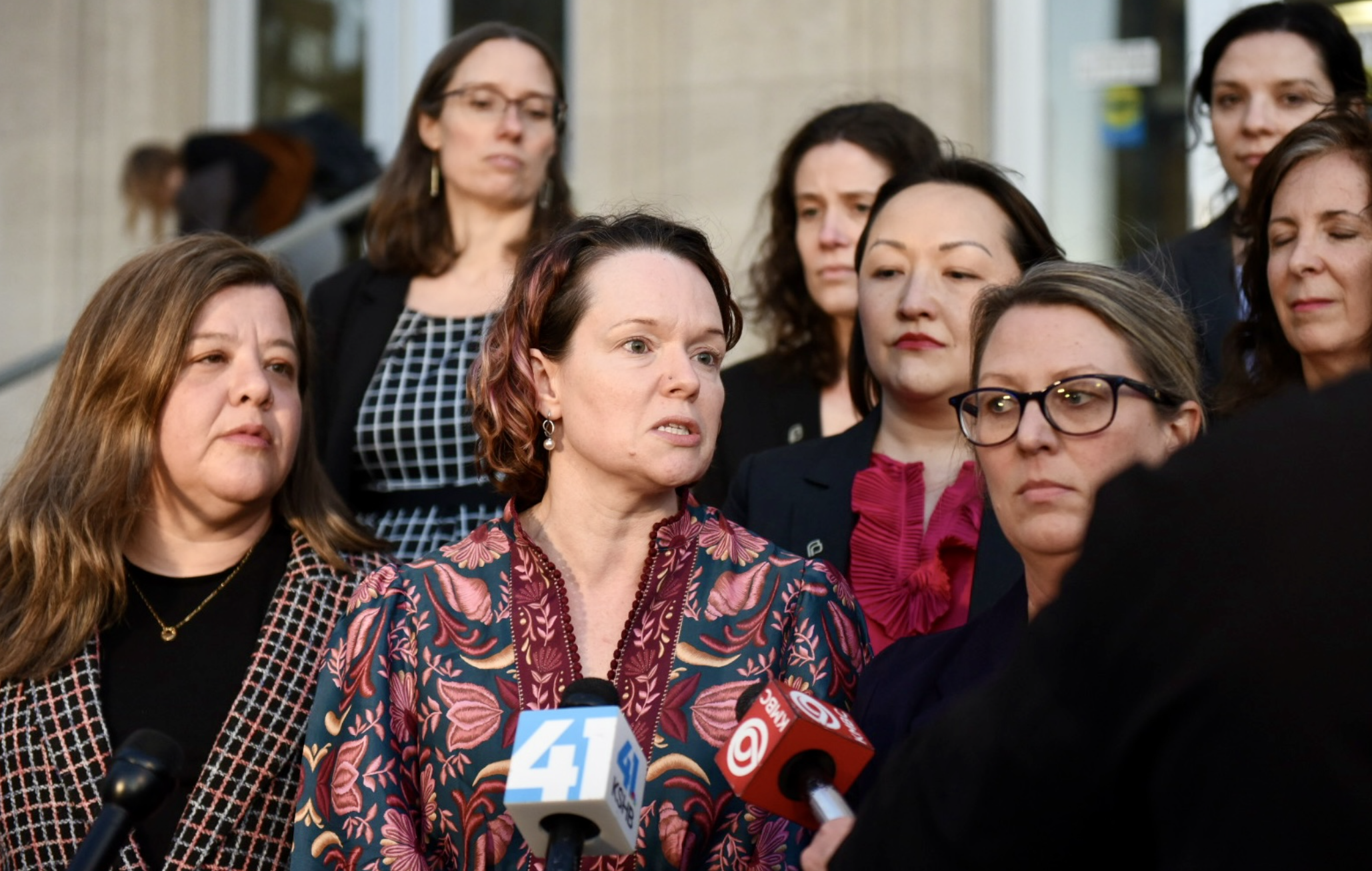
KANSAS CITY — Attorneys for Missouri’s only abortion provider presented a timeline Monday of two decades of restrictions on the procedure, laid out for a crowded courtroom across four easels.
On the opening day of what promises to be a 10-day trial over which regulations should remain in place under Missouri’s voter-approved abortion rights amendment, lawyers for Planned Parenthood argued the restrictions were “petty, demanding and increasingly aggressive,” and became increasingly so as more anti-abortion lawmakers were elected to the statehouse.
“The most consistent thing about abortion provisions in Missouri is that it’s been inconsistent,” Emily Wales, president and CEO of Planned Parenthood Great Plains, which operates clinics in Columbia and the Kansas City area, testified Monday.
As the trial kicked off in a Jackson County courtroom, the Missouri Attorney General’s Office renewed its plea for access to abortion patient records, including patient complaints and ER transfers. So far, a judge has denied the state’s attempt to access these records.
“We’ve had to fight tooth and nail to find smoking gun evidence,” Peter Donohue, an assistant attorney general, said Monday after appealing the court’s decision to allow Planned Parenthood to submit a summary chart of patient complications rather than records.
Vanessa Pai-Thompson, an attorney with Planned Parenthood Federation of America, called the state’s continued efforts “a last-ditch attempt to find a there there.”
Assistant Solicitor General Alexandria Overcash painted for the judge a picture of a hypothetical woman faced with an unintended pregnancy. Maybe she’s young and lacks a strong safety net. Maybe she can’t afford a baby, or is unsure if she is ready to be a mother.
Then Overcash detailed a world where the woman goes to an abortion provider and is shown an ultrasound. A state-mandated informed consent booklet is handed to her with other options and she is required to wait 72-hours before she can get an abortion.
This scenario, Overcash said, exists if the state’s current abortion regulations are upheld as part of a system designed to protect women in “emotionally fraught and medically-risky circumstances.”
But the first two witnesses in the case, called by Planned Parenthood, said dozens of unnecessary restrictions ensure access to abortion remains limited, if not impossible. As a result, only a few dozen in-clinic abortions were performed in recent years, as restrictions continued to pile up, compared to more than 20,000 a few decades earlier. Medication abortion remains inaccessible.
These restrictions came to a head in 2022, when the U.S. Supreme Court overturned the constitutional right to an abortion and Missouri’s trigger law banning nearly all abortions went into effect.
Two years later, 52% of Missourians voted to add reproductive health care protections, including access to abortion up to the point of fetal viability, into the state constitution. The amendment prevents the state from denying, interfering with or otherwise restricting abortion.
Planned Parenthood and the ACLU of Missouri sued the state a day after the vote, asking that a few dozen abortion regulations, commonly referred to as “targeted regulation of abortion providers” or TRAP laws, be struck down as unconstitutional under the new amendment.
The regulations, which will be dissected in court over the next two weeks, include:
- The state’s near-total abortion ban, as well as gestational limits on abortion.
- The required distribution of Missouri’s informed consent booklet prior to an abortion.
- A 72-hour waiting period between an initial appointment and an abortion.
- A requirement that the same doctor who saw the patient at the initial appointment also provide the abortion.
- A ban on prescribing medication abortion to patients via telemedicine.
- A requirement that only doctors be able to provide abortions.
- Abortion facility licensing requirements, including building specifications.
- Mandatory pelvic exams prior to the administration of medication abortion.
- Admitting privileges and a written transfer agreement at a nearby hospital.
- Complication plan for medication abortion that must be approved by the state health department.
- Providers who prescribe medication abortion must carry tail insurance that is effective for 21 years after the abortion takes place.
- All pregnancy tissue removed during procedural abortions must be submitted to a pathologist for review.
If the courts decide to strike down these regulations, Missourians will be able to access abortion closer to home and earlier in pregnancy, Dr. Margaret Baum, chief medical officer with Planned Parenthood Great Rivers, based in eastern Missouri, Springfield and Illinois, testified Monday.
The regulations being challenged in the lawsuit caused frustration for patients and made it difficult to hire and retain staff, Wales testified, especially for providers under the threat of criminalization.
“I felt under a microscope. I felt targeted. This is nothing like what I’ve experienced in a nursing home or hospital,” Wales recalls clinic staff saying.
The trial will resume Tuesday morning, when several more Planned Parenthood employees are expected to testify.