


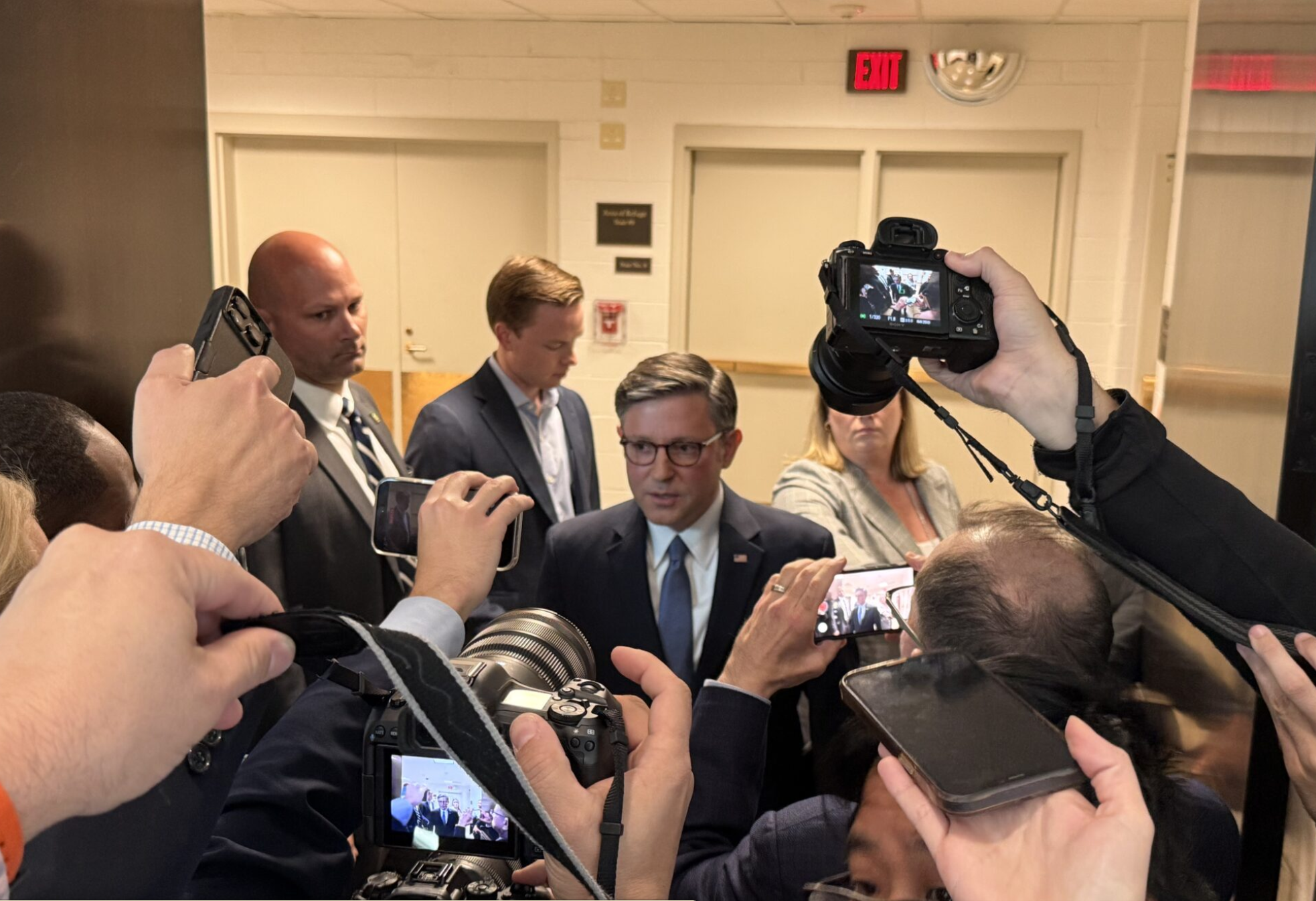
WASHINGTON — U.S. House Speaker Mike Johnson said Tuesday he will not allow a floor vote this week on a bipartisan amendment supported by moderate Republicans that would extend the Affordable Care Act enhanced tax credits.
Johnson was confident that blocking the amendment would not lead centrist GOP lawmakers to oppose the Republican health care bill scheduled to get a vote Wednesday.
“There’s about a dozen members in the conference that are in these swing districts who are fighting hard to make sure they reduce costs for all of their constituents. And many of them did want to vote on this Obamacare, COVID-era subsidy the Democrats created,” Johnson said. “We looked for a way to try to allow for that pressure release valve and it just was not to be.”
The enhanced ACA tax credits are set to expire at the end of the year, sharply increasing the cost of health insurance for the roughly 22 million Americans who purchase plans through the exchange and benefit from the subsidies.
The House Republican health care bill wouldn’t extend those tax credits, frustrating GOP lawmakers in that chamber who are most at risk of losing their reelection bids during the November midterm elections.
Johnson said he expects that GOP bill will pass, though he didn’t address its prospects in the Senate, where bipartisanship is needed for nearly all bills to advance under that chamber’s 60-vote legislative filibuster.
‘Idiotic and shameful’
New York Republican Rep. Mike Lawler said in a speech on the House floor that GOP leaders’ decision to let the enhanced ACA tax credits expire was “idiotic and shameful,” especially after changes were added to address fraud and reduce costs.
“So we have been forced to sign onto two discharge petitions,” he said. “And yet my Democratic colleagues will not join us, but for those that were at the negotiation table.”
Lawler then criticized House Minority Leader Hakeem Jeffries, of New York, for not encouraging Democrats to sign onto the bipartisan discharge petitions, noting that would likely get the 218 signatures needed to force a floor vote. He argued that’s because Jeffries “doesn’t actually want to solve the problem, he wants the issue.”
“This place is disgraceful,” Lawler said. “Everybody wants the upper hand. Everybody wants the political advantage. They don’t actually want to do the damn work. This problem could be solved today if everybody who says they care about extending this signs the discharge.”
GOP-only bill in 2026?
When the House returns from its two-week holiday break next year, Johnson said, leaders may try to use the complex reconciliation process they used to enact the “one big, beautiful bill” to address health care.
“What we anticipate going into the first quarter of next year is, possibly in a reconciliation package or in regular order a stand-alone, ideas just like this,” Johnson said after being asked a question about Health Savings Accounts. “We have a long list of things that we know will reduce premiums, increase access and quality of care.”
President Donald Trump said Monday he wants Republicans to use the reconciliation process or to eliminate the Senate’s legislative filibuster to address health care and other policy priorities.
“Republicans should knock out the filibuster and we should approve a lot of things,” Trump said.
Senate Majority Leader John Thune, R-S.D., has said repeatedly he doesn’t intend to change or scrap the filibuster.
Direct payments or tax breaks
Trump also reiterated during the Oval Office event he would like to see Congress send direct payments to Americans to help them buy health insurance or afford health care.
“I want all money going to the people and let the people buy their own health care. It’ll be unbelievable,” Trump said. “They’ll do a great job. They’ll get much better health care at a much lower cost.”
The Senate voted last week on two health care bills, one from Republicans and one from Democrats, but neither received the support needed to move toward a final passage vote.
Republicans’ bill would have provided direct payments to some people enrolled in either bronze or catastrophic ACA marketplace plans with up to $1,500 in payments annually for 2026 and 2027.
Democrats’ legislation would have extended the enhanced ACA marketplace tax credits for three years.
Cost most urgent issue, poll finds
A bipartisan group of senators is trying to find solutions that bridge the political divide, though they are unlikely to achieve consensus on the details before the end of this week.
A poll released Monday by the West Health-Gallup Center on Healthcare in America shows that cost is the “most urgent” health issue facing the country, followed by access and then obesity.
Just 57% of those polled said they were satisfied with how much they pay for their own health care and only 16% were satisfied with the total cost of healthcare.
Nearly two-thirds of those in the survey said they believe it’s the federal government’s responsibility “to make sure all Americans have healthcare coverage,” while 33% said it’s not.